
Endless Track Mechanics
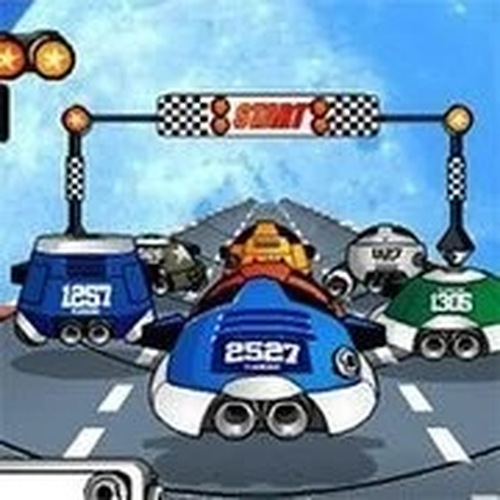
Galaxy Speedway Runner places you behind the controls of a sleek spacecraft moving automatically along a procedurally generated course. Unlike traditional racing games with fixed circuits, this experience offers an infinite route where the environment rearranges itself continuously. Each run presents a unique sequence of twists, turns, and hazards, ensuring that no two attempts feel identical. The core loop is straightforward: survive as long as possible while maintaining momentum to cover greater distances.
Scoring Through Star Collection
Scattered across the track are bright stellar tokens that serve as the primary method for increasing your score. These orbs appear in varying patterns, sometimes clustered together and other times spaced far apart. Deciding whether to risk veering off a safe path to grab a cluster of stars or stay on a conservative route becomes a strategic element. The score reflects both survival time and collection efficiency, rewarding players who can balance caution with ambition.
Obstacle Patterns and Reaction Training
The track is populated with static and moving obstacles, including rocky debris and metallic barriers. These hazards appear in predictable patterns that players can learn over repeated attempts. Early sections introduce simple single obstacles, while later stretches combine multiple threats that require precise timing to navigate. The game gradually increases difficulty by introducing faster obstacle sequences and tighter gaps, providing a natural skill progression curve.
Visual Design and Atmosphere
The visual presentation uses a vibrant palette with neon accents against a deep space backdrop. Stars, nebula clouds, and distant galaxies create an immersive sense of speed and scale. The spacecraft leaves a light trail that helps players gauge their trajectory. The interface is minimal, with score and distance displayed clearly without cluttering the view. This clean design keeps the focus on the action and helps players react quickly to upcoming obstacles.
Accessibility and Session Flexibility
Controls are limited to left and right steering, making the game immediately playable for newcomers. The absence of acceleration or braking mechanics removes complexity, allowing players to concentrate entirely on navigation. Each run typically lasts between one and five minutes, making it suitable for quick breaks or extended play sessions. The simple input scheme also means the game works well on both keyboard and touchscreen devices without requiring adaptation.
Progression and Replay Motivation
While there is no explicit level structure or unlockable content, the primary motivation comes from beating personal best scores and distances. The dynamic track generation ensures that high scores are earned through skill rather than memorization. Players who invest time will notice improvements in their reaction speed and pattern recognition. The lack of an ending point means the challenge is self-defined, with each new attempt offering a chance to surpass previous achievements.







Comments
0 comments